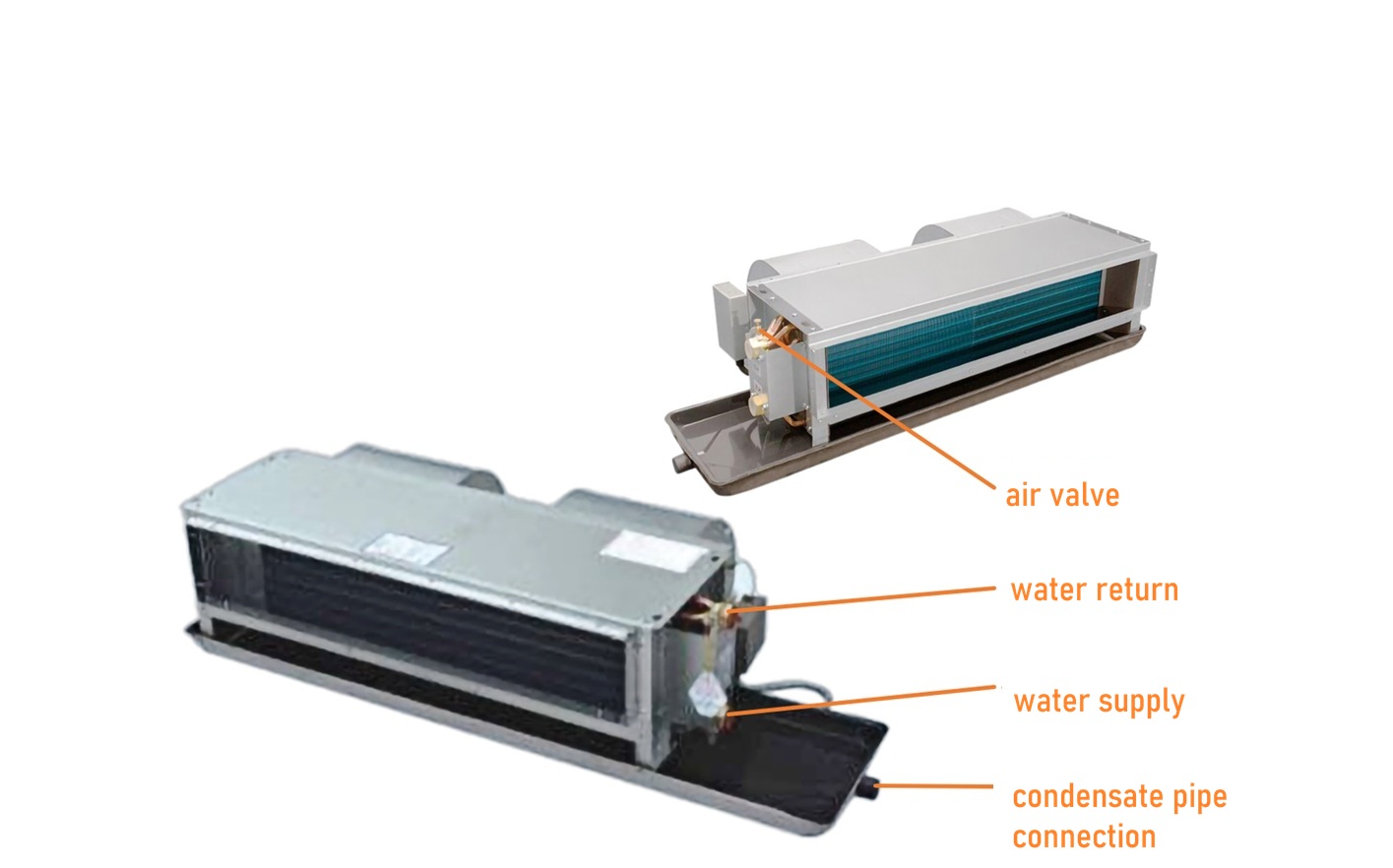
Installation of FCU : bottom supply & top return (BS&TR)
When doing the installation of fan coil units ( FCU ), water inlet and water outlet are usually arranged in the way that supply from below and return from above. That means, the water supply pipe is installed below, then valve components such as inlet gate valves, filters, and metal hoses are installed in turn; The return pipe is installed on top, then valve components such as metal hoses, electric two-way valves, and outlet gate valves are installed in turn.
Why should we install FCU in the way: bottom supply & top return (BS&TR)
1. Beneficial for air exhaust
When adopts Water Supplies from Lower Part and Water Returns to Upper Part, the water flows inside the fan coil from lower to upper, which is beneficial for air escaping from the water to gather upwards along the water current, and ultimately be discharged from the system through the exhaust valve attached to the upper pipe of the fan coil, reducing air block.
After the first water filling or long-term operation of the water system, air is prone to accumulate inside the fan coil. If the upper in and lower out is used, the water and air flows reversely, and air is prone to accumulate at the upper part and inside of the fan coil, forming air lock that hinder water current and lead to heat transfer failure.
2. Improve heat exchange efficiency
When upper supply and lower return, the direction of water flow is the same as that of air rising up, which can effectively reduce the “air lock” caused by air trapped in the upper part or bend of the fan coil, maintain the continuity of water flow in the fan coil and sufficient contact with the heat exchange surface, thereby improving the overall heat transfer performance.
The phenomenon of air block inside the fan coil not only affects the smoothness of water flow, but also causes additional noise or water hammer.
3. Protect electrical valves
In the installation of fan coil units, control valves with electrical actuators are usually installed on the upper return pipe to avoid the impact of pipe leakage on the electrical device.
4. Convenient maintenance and cleaning
In the installation of fan coil units, a filter needs to be installed on the inlet pipe. When using bottom supply & top return, the filter is installed on the lower inlet pipe, which can be easily cleaned and maintained through the ceiling inspection part.
5. Comply with design specifications and construction rule
In the HVAC design regulation and construction rules, it is explicitly recommended to use the ” bottom supply & top return ” connection, which has become a common practice in the HVAC industry, facilitating construction, commissioning, and maintenance in practical engineering.
To sum up, the installation of fan coil units adopts ” bottom supply & top return “, which is conducive to the collection of air in the water and discharge freely, reducing air lock in the fan coil units and improving heat transfer efficiency. The electrical control valve is installed on the upper return water pipeline to reduce the risk of pipeline leakage, and the filter is installed on the lower water supply pipeline for easy maintenance and cleaning. This is the practice in the HVAC industry, which helps to unify construction, commissioning, and maintenance.
# HVAC # # Heat Transfer # # Fan Coil Unit #